Hi there! I'm Marco Antonio Parra.

AI Engineer — Generative AI (LLM, RAG), computer vision and Python backend / MSc in Industrial Engineering
Engineer with an MSc in Industrial Engineering and close to 15 years of career experience: from 2011 to 2019 in industrial operations, with teams of up to 50 people and already designing data capture and analysis systems inside that role; the shift consolidated through the MSc — thesis in metaheuristic optimization — and intensive training between 2020 and 2023; and since 2024, artificial intelligence systems: from prototypes to deployed services. Specialized in applied AI with engineering judgment: RAG pipelines over self-hosted open-weight language models, vector databases, computer vision, and backend architectures with FastAPI and Docker; I take models from dataset to deployed service, with verifiable metrics and documented architecture decisions. AWS Certified Solutions Architect — Associate. Explore the projects below, or connect on LinkedIn.
MY SKILLS
AI & COMPUTER VISION
PyTorch | YOLOv8 / YOLO11 | SAM | SAHI | OpenCV | MLOps | MLflow | CVAT | LLMs | vLLM | RAG | Embeddings | ChromaDB
BACKEND & DATA
Python | FastAPI | Django | DRF | REST APIs | Microservices | PostgreSQL | Celery | Redis | Pandas | NumPy | SQL | ETL pipelines


INFRASTRUCTURE
Docker | Linux | AWS | Huawei Cloud | CI/CD (GitHub Actions) | pytest | Prometheus | Grafana


INDUSTRIAL & ANALYTICS
LANGUAGE
Spanish (native)
WORK EXPERIENCE
EDUCATION
CERTIFICATIONS & BADGES











PROJECTS
Projects
Metaheuristic Optimization for Job Shop Scheduling (NP-hard)
- This project addresses a classic production scheduling problem, where multiple jobs must be processed across different machines under strict delivery deadlines. It is MSc research: the methods were evaluated on nine standard Taillard benchmark instances, not on data from a single plant.
The objective of the system was to minimize total tardiness in a Job Shop Scheduling Problem (JSP), a combinatorial optimization problem classified as strongly NP-hard. Due to the computational complexity of the problem, traditional exact optimization methods become impractical for real-world scenarios, making heuristic and metaheuristic approaches necessary.
The solution was developed as part of an academic research collaboration and implemented as a computational optimization engine capable of generating efficient production schedules within practical runtimes.
The proposed methodology integrates several metaheuristic strategies, including:
- GRASP (Greedy Randomized Adaptive Search Procedure)
- Variable Neighborhood Search (VNS)
- Iterated Local Search (ILS)
- Hybrid metaheuristic models combining construction and local search phases
The system evaluates candidate schedules using performance metrics such as:
- Total tardiness reduction
- Convergence time
- Exploration capacity
- Statistical significance of results
A statistical validation framework was implemented using the Tukey test to determine whether differences between metaheuristic approaches were statistically significant, ensuring methodological rigor in the evaluation process.
Experimental results demonstrated that hybrid metaheuristic approaches combining GRASP and VNS consistently achieved superior performance compared to standalone methods, particularly for larger problem instances.
The system was implemented using Python and evaluated in a controlled environment for reproducibility.
This project represents an applied optimization and algorithm design effort that integrates operations research, algorithm engineering, and industrial decision-support systems.
Programming Language
Python 3.x
Main programming language used for implementing metaheuristic optimization algorithms and experimental simulations in Job Shop Scheduling environments.
Core Python Libraries
pandas
Used for:
Data manipulation | Experimental result storage | Scheduling representation | CSV export | Performance tracking
NumPy
Used for:
Numerical computation | Matrix initialization | Scheduling simulation | Vectorized operations
sqlite3
Used for:
Persistent storage of benchmark instances | Structured data retrieval | Database-driven experimentation
random
Used for:
Stochastic solution generation | GRASP candidate selection | VNS neighborhood exploration
time
Used for:
Runtime control | Convergence measurement | Stopping criteria implementation
math
Used for:
Mathematical computations | Numerical evaluation
Matplotlib
Used for:
Gantt chart generation | Makespan visualization | Scheduling performance analysis | System Architecture Style
Scientific Computing Application
Characteristics:
-Algorithmic experimentation
-Metaheuristic optimization
-Iterative simulation
-Performance benchmarking
Metaheuristic Algorithms
-GRASP
-Variable Neighborhood Search (VNS)
-Iterated Local Search (ILS)
-Combinatorial Optimization
-Operations Research
-Statistical Analysis
-Scheduling Algorithms
The source code is not publicly available. This project is presented as a technical case study describing the system design, methodology, and performance results.
- Technology:
- Optimization Algorithms | Python
- Company:
- Universidad del Bío-Bío, Industrial Engineering Department
- Technology stack:
- Python | Pandas | pip | Sqlite3 | Numpy | time | math | matplotlib | Seaborn | Scipy | Statmodels
- Developer:
- Marco Antonio Parra Fernández
Felipe T. Muñoz
AgriDrone Vision Evaluation Pipeline
- AgriDrone Vision Evaluation Pipeline is a generalized and anonymized technical case study of an applied computer vision and geospatial machine learning system for agricultural drone imagery.
The project documents the design of an end-to-end ML engineering workflow capable of processing high-resolution UAV images and videos, running object detection models, validating model performance, generating reproducible evaluation artifacts, enriching detections with geospatial metadata, and exporting results into formats suitable for GIS analysis, technical reporting, and downstream agricultural decision-support workflows.
At its core, the system focuses on applying YOLOv8 / YOLO11 object detection models to agricultural imagery captured by drones. The pipeline supports both direct YOLO inference and SAHI-based sliced inference, which is especially useful for high-resolution images where small objects may be lost during resizing. SAHI allows the image to be divided into overlapping slices, processed independently, and reconstructed into full-image detections, improving the ability to detect small or dense objects in aerial scenes.
The documented workflow includes several stages of the machine learning lifecycle: dataset configuration, model training orchestration, validation, benchmarking, automatic best-model selection, inference, post-processing, evaluation, visualization, geospatial export, and technical documentation. It is not presented as a simple model-training notebook, but as a broader ML engineering system that connects experimentation, inference, evaluation, and geospatial analysis.
The training and validation layer describes how YOLO models can be trained and evaluated across different configurations such as model version, image size, batch size, confidence threshold, device selection, and dataset structure. It also documents model-selection logic based on experiment metrics, allowing the system to identify the best available `best.pt` checkpoint from previous runs. The validation and benchmarking workflow includes global metrics, per-class metrics, inference timing, GPU-aware execution considerations, and reproducible artifact generation.
The evaluation layer includes COCO-style evaluation concepts, conversion of YOLO annotations and predictions into COCO-compatible structures, and the calculation of metrics such as AP50, AP50:95, precision, recall, and F1-score. The documentation distinguishes between YOLO-native validation metrics, COCO-style evaluation metrics, and operational inference outputs, making clear that each type of metric answers a different question about model performance.
The inference layer supports processing individual images, full directories of images, high-resolution drone imagery through SAHI, and video inputs. For static imagery, the system generates styled images with bounding boxes, class labels, confidence scores, per-image JSON metadata, batch summaries, and geospatial outputs. For video, the system documents a dedicated video inference and object tracking processor that uses YOLO tracking IDs to count unique objects across frames, render annotated videos, generate JSON summaries, and optionally produce frame-level SRT artifacts.
A major part of the project is the integration between computer vision and geospatial processing. The system does not stop at object detection. It enriches detections with EXIF/GPS metadata when available, converts latitude and longitude into UTM coordinates, and prepares structured spatial outputs for GIS workflows. These outputs may include GeoJSON, CSV, Shapefiles, QGIS-compatible summaries, and spatial metadata records. This allows model predictions to be inspected, analyzed, and visualized in geospatial tools instead of remaining isolated as pixel-space bounding boxes.
The project also documents a raster georeferencing workflow for styled detection images. This includes copying EXIF/XMP metadata from original drone images, generating JGW world files for styled JPEG outputs, documenting CRS assumptions, supporting optional GeoTIFF fallback, and enabling QGIS-oriented raster loading workflows. This raster-oriented layer is separate from vector outputs like GeoJSON and Shapefiles, and it addresses the practical need to visually overlay annotated detection imagery inside GIS tools.
The video processing component introduces a different type of complexity because video inference is not simply image inference repeated over frames. It includes temporal state, frame decoding, YOLO `model.track()` execution, extraction of bounding boxes and tracking IDs, unique object counting, rendering of overlays, video writing, SRT generation, frame-level error handling, and resource finalization. The documentation captures risks such as tracker ID instability, missing `box.id` values, RGB/BGR color-space issues, JSON serialization problems, and performance bottlenecks caused by frame-by-frame processing.
The system also documents important engineering constraints and trade-offs. These include SAHI runtime overhead, GPU/CUDA memory pressure, cuDNN runtime assumptions, filesystem-based experiment lineage, path fragility, lack of formal retry logic, absence of background workers, output idempotency concerns, metadata quality issues, CRS ambiguity, and the difference between a research-grade batch pipeline and a fully production-ready platform. These limitations are intentionally documented to show realistic engineering judgment rather than presenting the system as a finished enterprise product.
From a software architecture perspective, the project is organized around several conceptual services and processing layers: CLI orchestration, model selection, training, validation, benchmarking, inference, SAHI reconstruction, video tracking, geospatial enrichment, raster georeferencing, GIS export, reporting, and documentation rendering. The current public version describes these as generalized architectural components rather than publishing proprietary source code or institutional implementation details.
The repository is intended to demonstrate applied ML engineering capabilities across multiple domains: computer vision, object detection, high-resolution image processing, geospatial metadata handling, GIS integration, video analytics, evaluation methodology, GPU-aware workflows, and technical documentation. It shows how a machine learning pipeline can be extended beyond model inference into reproducible evaluation, spatial intelligence, reporting, and practical analysis workflows.
This public repository is a sanitized portfolio version. It does not include private datasets, source code from proprietary systems, trained model weights, real drone imagery, real field coordinates, real shapefiles, real GeoJSON outputs, production credentials, institutional or client names, unpublished experimental results, or confidential operational details. The documentation is presented as a generalized technical case study focused on architecture, methodology, engineering decisions, and system design patterns.
- Technology:
- AI / Computer Vision
- Company:
- Anonymized Agricultural Computer Vision R&D Case Study
- Technology stack:
- Python, PyTorch, Ultralytics YOLOv8/YOLO11, SAHI, OpenCV, Pillow, NumPy, Pandas, pycocotools, ClearML, CUDA, cuDNN, EXIF/GPS metadata processing, UTM coordinate conversion, GeoJSON, Shapefile, JGW world files, GeoTIFF, QGIS, PyQGIS, GDAL/OGR, Markdown documentation
- Developer:
- Marco Parra
YOLO Training & Inference Orchestration Architecture
- YOLO Training & Inference Orchestration Architecture is a public, sanitized architecture case study of an internal, production-oriented AI vision platform. It documents how a user-facing web layer is kept separate from GPU-intensive machine learning workloads, and explains the rationale for that separation.
It is documentation only: no runnable application code, private datasets, model weights, credentials, real metrics or production deployment files.
What it documents:
- Microservice separation: a Django web and administration layer separated from a FastAPI-based AI processing layer.
- GPU-backed AI execution: YOLO training, validation, inference and SAHI-based high-resolution tiled inference, executed through a dedicated compute service.
- Training runtime flexibility: single-GPU and multi-GPU training strategies, including DataParallel support and evaluated DDP patterns.
- Dataset configuration management: database-backed dataset configuration, label and class metadata, and YOLO-compatible dataset configuration generation.
- MLOps foundations: experiment tracking, metric logging, artifact lineage and model reference management.
- Operational risk analysis: explicit discussion of synchronous execution, shared storage coupling, GPU contention, artifact governance and scale-out triggers.
- Fit-for-purpose evolution planning: a roadmap focused on internal reliability and traceability rather than premature distributed infrastructure.
One documented decision, as an example of the level of detail: Ubuntu was selected as the runtime environment for GPU-backed training because PyTorch, CUDA, NVIDIA drivers and multi-GPU training are highly sensitive to operating system, driver and CUDA-runtime compatibility. Windows was suitable for simpler single-GPU execution, but multi-GPU and DDP-oriented workflows introduced operational complexity that Ubuntu avoided.
The four diagrams shown here are rendered from the Mermaid sources committed in the repository: architecture overview, training flow, SAHI tiled inference flow, and incremental CI training.
- Technology:
- AI / Platform Architecture
- Company:
- Anonymized Internal AI Vision Platform — Architecture Case Study
- Technology stack:
- Python, Django, FastAPI, PostgreSQL, REST APIs, PyTorch, CUDA, YOLO, SAHI, OpenCV, SAM (Segment Anything), Pillow, NumPy, ClearML, YAML, JSON, COCO annotation format, YOLO dataset format, CVAT, Roboflow, Docker, Docker Compose, Linux, Ubuntu, Jupyter, shared storage for artifact exchange
- Developer:
- Marco Parra
Dimensional Control of Sawn Lumber: from a Spreadsheet to a System
- Documentation-only case study of a quality-control method and data-acquisition system for small and mid-sized sawmills, developed between 2017 and 2019 in technology-transfer work in Chile.
Problem: sawmills measured lumber with digital calipers, wrote readings on paper and typed them in later — producing measurements too late to influence the process.
Method: four control points per piece, nominal vs. target size (after drying shrinkage and planing), context on every record, and four statistical outputs: standard deviation per machine and cut, histogram against tolerance, under/over-size hit rate per control point, box plot per machine.
Prototype (Nov 2017, joint INFOR-CETMA project): an Excel workbook with macros tested with real plants. Concept (Dec 2018, CETMA): caliper with data output -> Android app that attaches batch context -> web platform with alerts against NCh 2824 tolerances. The concept was the technical basis of a CORFO Technology Diffusion Project awarded to Universidad de Concepcion (2019) and of the module INFOR implemented on open, low-cost Bluetooth calipers; the author coordinated the developer's hiring and initial stage, and the workbook's calculation logic was ported into the system.
No spreadsheet, plant data, operator names, suppliers or source code are published. The resulting applications are owned and maintained by INFOR.
- Technology:
- Operations / Data Acquisition
- Company:
- INFOR / CETMA (Universidad de Concepción) — documentation-only case study
- Technology stack:
- Statistical process control (control charts, tolerance histograms, hit rate, box plots), NCh 2824, Excel (formulas, advanced filters, named ranges, VBA macros), system concept: Bluetooth digital caliper -> Android app -> web platform, CORFO PDT formulation, technology transfer to SMEs
- Developer:
- Marco Parra (method, prototype, system concept, specification)
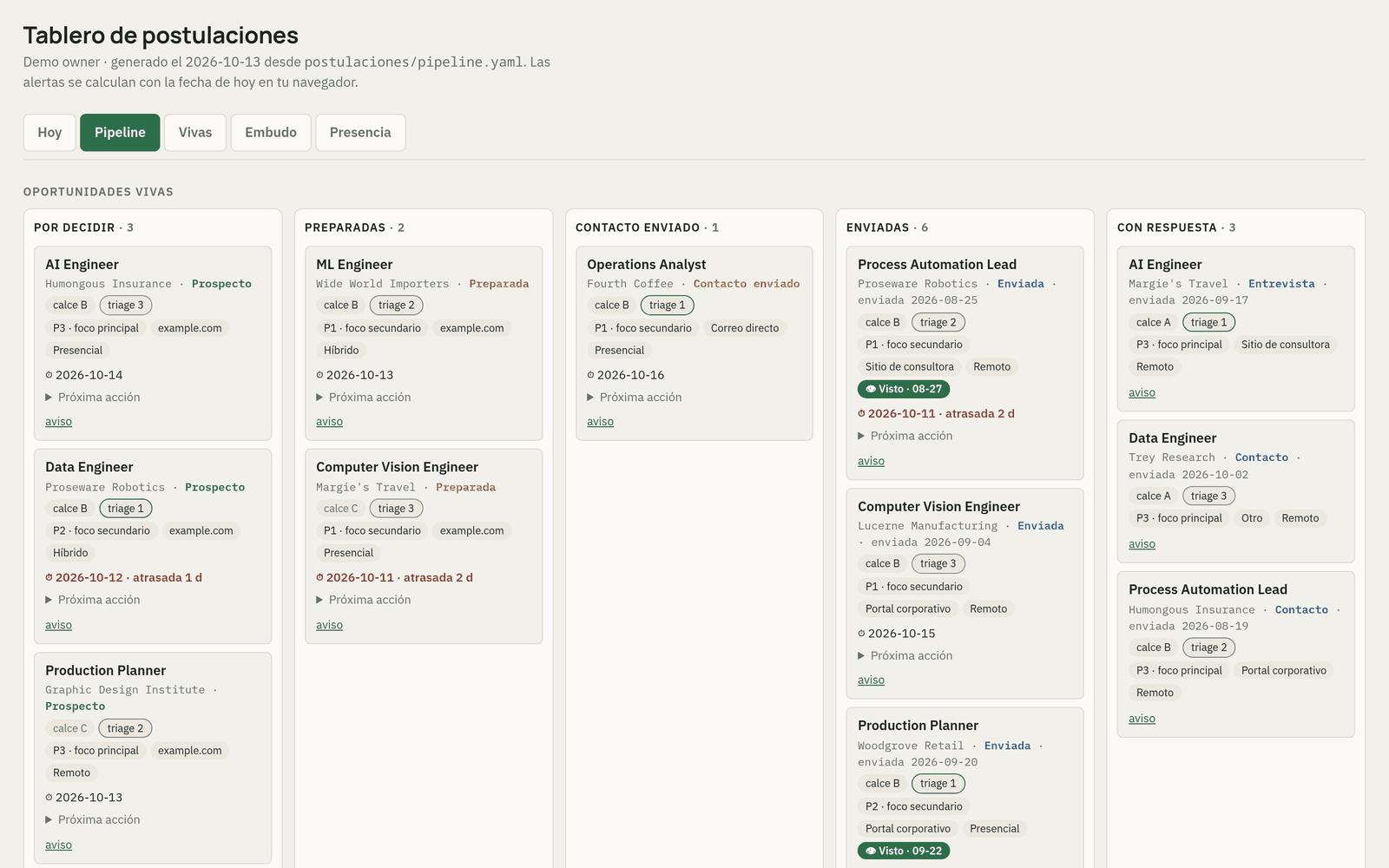
Job Search Agent System: Human-in-the-Loop Decision Support
- Context: A job search is hundreds of small decisions a week: which posting to read, which to discard, what each CV should say. An AI agent reads and writes fast, but it can also invent a fact, forget a rule or attach the wrong file. This system pairs an agent with written rules, a library of verified facts and blocking checks.
Role: Sole designer and daily operator: process, rules, controls and data architecture. Much of the code was written by the agent under my direction and review. The private system is not published; the public repository holds its design and reference implementations written from scratch, with invented data.
Decisions: A human approval bound to a fingerprint of the exact text approved: if the text changes, the document is blocked. Gates block, never warn. Owner rules carry a date, so a changed rule reopens the discards it justified. One fact lives in one file: a per-posting CV only selects and orders fragments, it never writes a claim. The agent is evaluated against the owner's decisions in both directions.
Result: About 14,800 postings seen, 822 analyzed in writing, 77 documents sent, none without the owner approving its full text. 12 blocking checks per application. The owner authorized all 33 agent recommendations and reopened 5 of its 789 discards. Public repository with CI: tests, sanitization gate, a numbers check and a rendered-page test.
- Technology:
- AI / Agentic Systems
- Company:
- Personal — private system in daily use, public documentation and reference code
- Technology stack:
- Claude Code (skills, hooks, memory, CLAUDE.md), Python (standard library + PyYAML), Bash, LaTeX (LuaLaTeX), poppler, Pandoc, Node.js + Playwright, HTML/CSS/JavaScript, YAML + JSON Schema, Ollama (local 3B model), GitHub Actions
- Developer:
- Marco Parra (design, rules, controls, data architecture, daily operation); code written largely by the agent under review


ABOUT ME

Hi there! I'm Marco Antonio Parra Fernández, an AI and backend engineer based in Chillán, Chile.
Engineer with an MSc in Industrial Engineering and close to 15 years of career experience: from 2011 to 2019 in industrial operations, with teams of up to 50 people and already designing data capture and analysis systems inside that role; the shift consolidated through the MSc — thesis in metaheuristic optimization — and intensive training between 2020 and 2023; and since 2024, artificial intelligence systems: from prototypes to deployed services.
Specialized in applied AI with engineering judgment: RAG pipelines over self-hosted open-weight language models, vector databases, computer vision, and backend architectures with FastAPI and Docker; I take models from dataset to deployed service, with verifiable metrics and documented architecture decisions. AWS Certified Solutions Architect — Associate.
On the industrial side I led production planning and shift operations in the forestry sector, and ran technology-transfer programmes for dozens of SMEs. That background is the reason I read a production process and the system that should optimise it as one problem, not two.
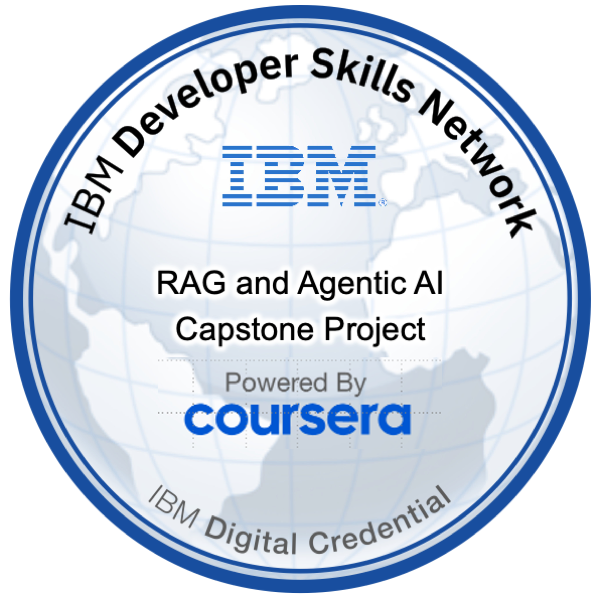
Certified as an AWS Certified Solutions Architect – Associate and AWS Certified Cloud Practitioner, with IBM professional certificates in Generative AI Engineering and in RAG and Agentic AI. Every credential in the section above links to its verifiable badge.
Explore the projects below, or connect on LinkedIn.