PROJECT DETAILS
Metaheuristic Optimization for Job Shop Scheduling (NP-hard)
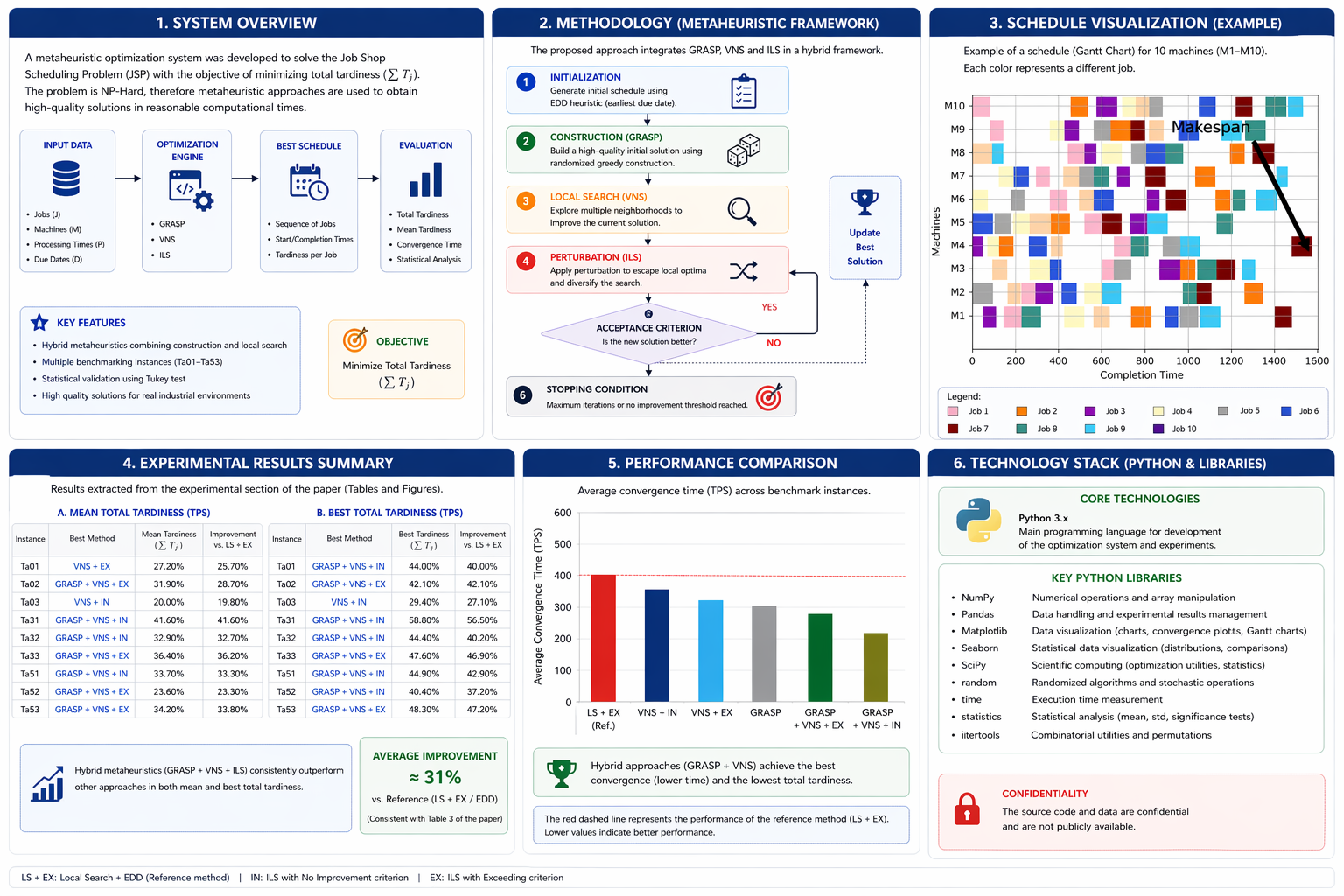
This project addresses a classic production scheduling problem, where multiple jobs must be processed across different machines under strict delivery deadlines. It is MSc research: the methods were evaluated on nine standard Taillard benchmark instances, not on data from a single plant.
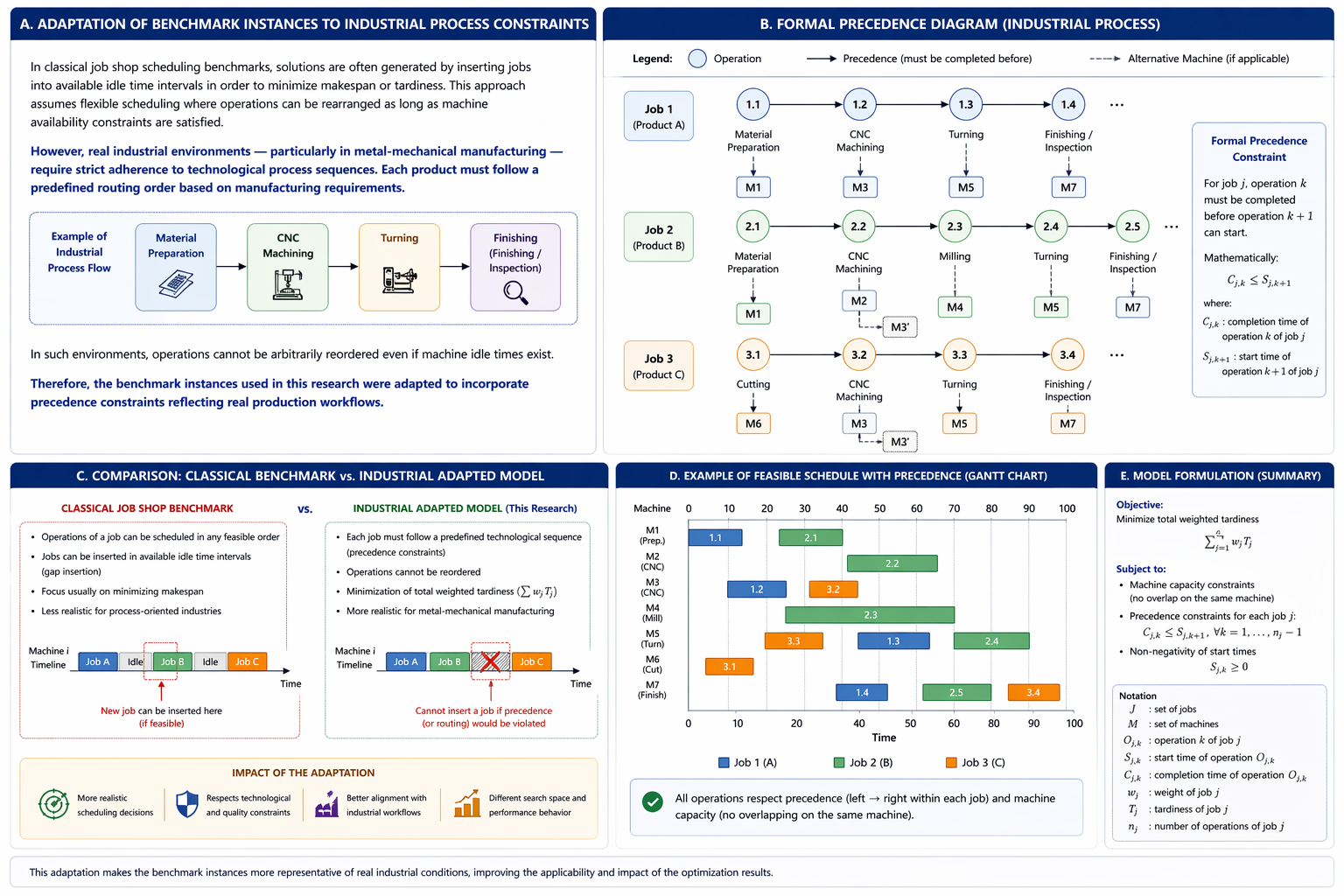
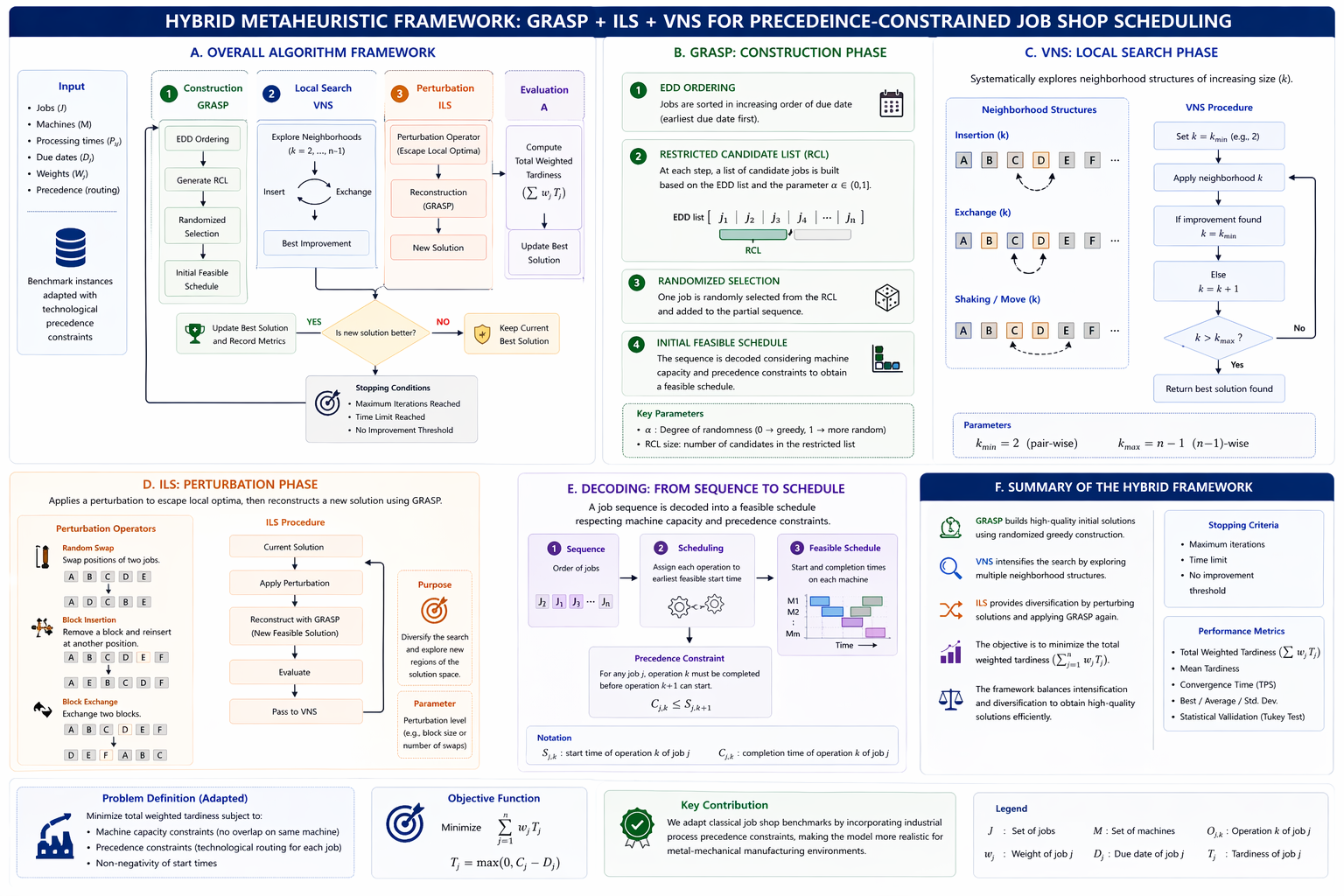
The objective of the system was to minimize total tardiness in a Job Shop Scheduling Problem (JSP), a combinatorial optimization problem classified as strongly NP-hard. Due to the computational complexity of the problem, traditional exact optimization methods become impractical for real-world scenarios, making heuristic and metaheuristic approaches necessary.
The solution was developed as part of an academic research collaboration and implemented as a computational optimization engine capable of generating efficient production schedules within practical runtimes.
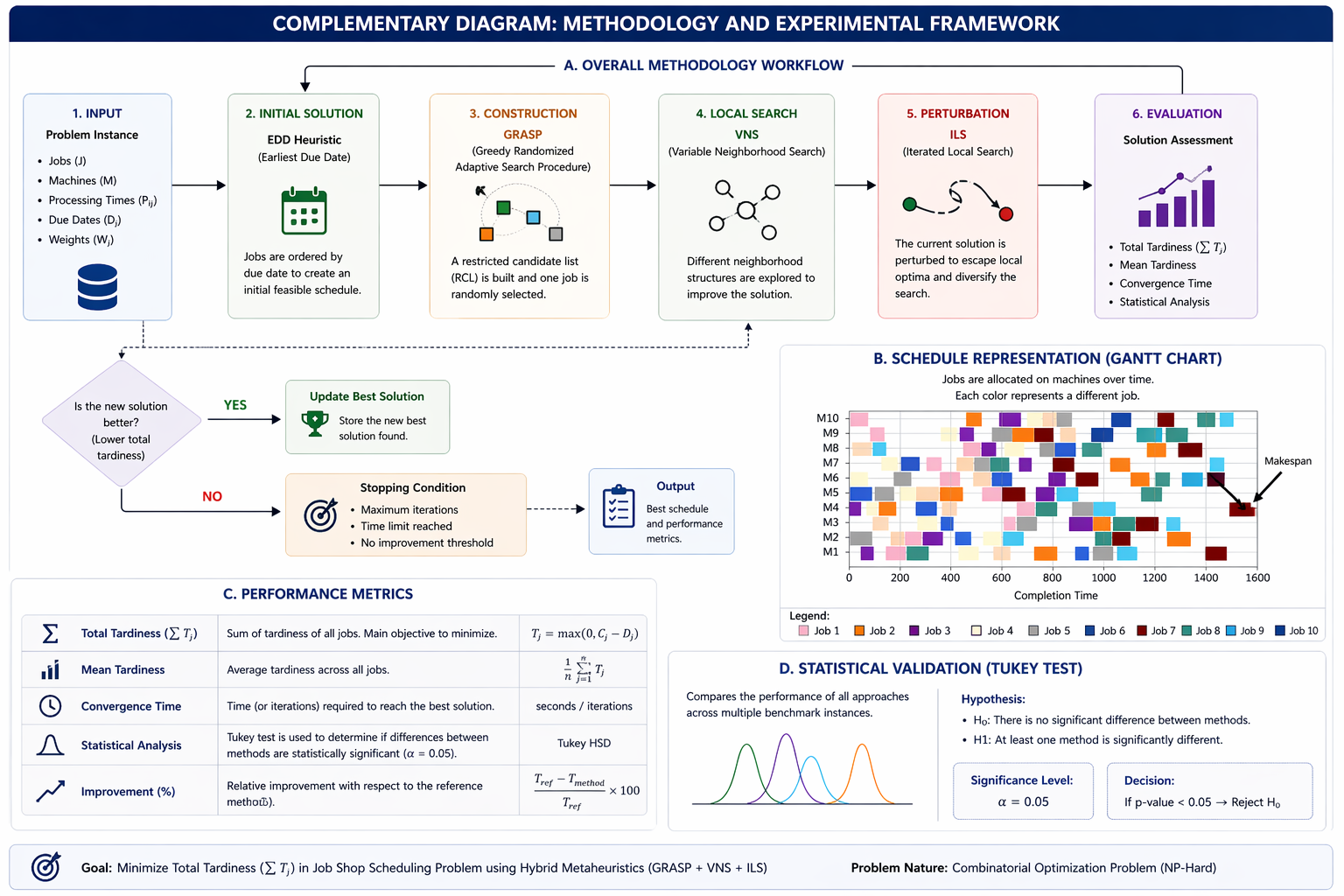
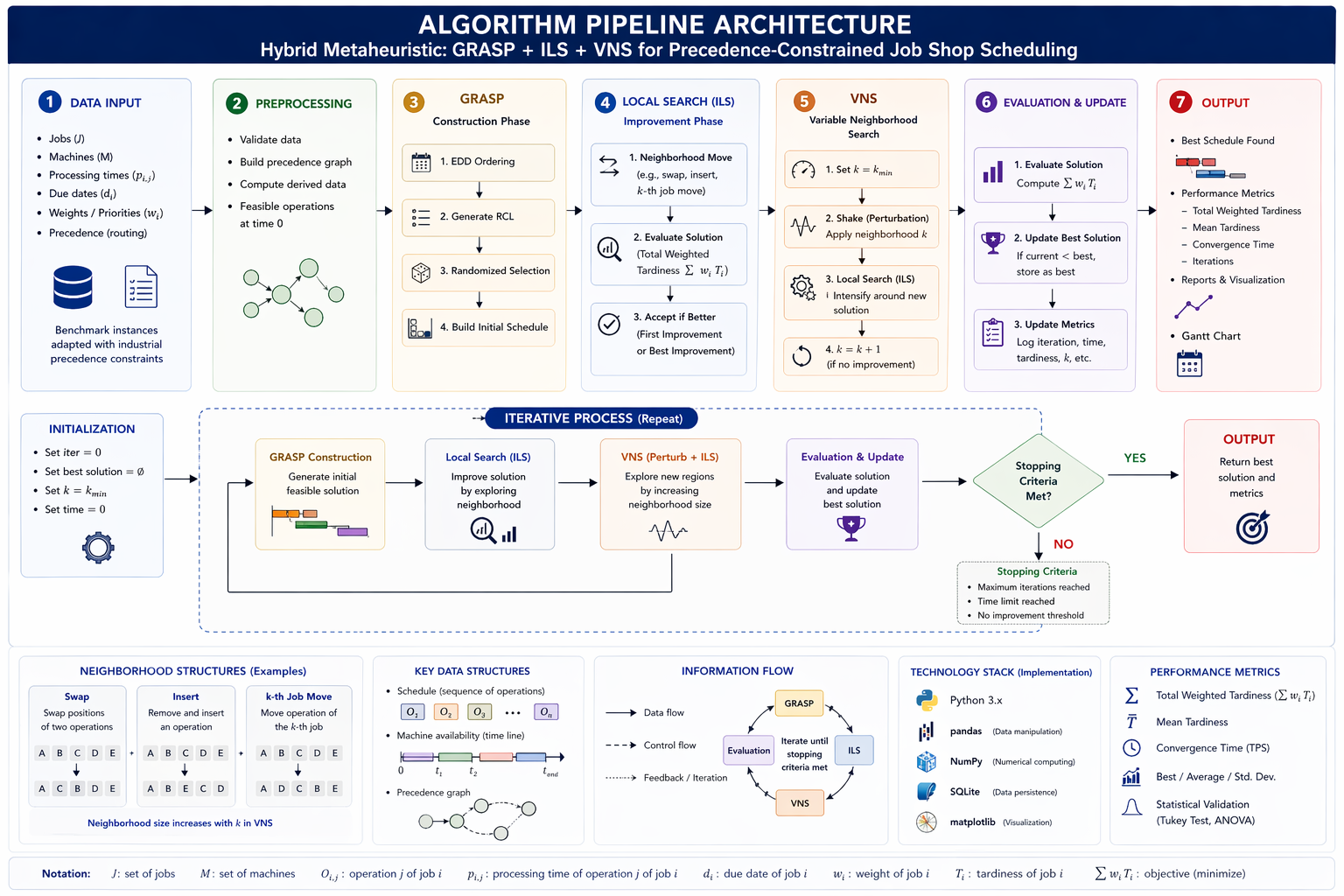
The proposed methodology integrates several metaheuristic strategies, including:
- GRASP (Greedy Randomized Adaptive Search Procedure)
- Variable Neighborhood Search (VNS)
- Iterated Local Search (ILS)
- Hybrid metaheuristic models combining construction and local search phases
The system evaluates candidate schedules using performance metrics such as:
- Total tardiness reduction
- Convergence time
- Exploration capacity
- Statistical significance of results
A statistical validation framework was implemented using the Tukey test to determine whether differences between metaheuristic approaches were statistically significant, ensuring methodological rigor in the evaluation process.
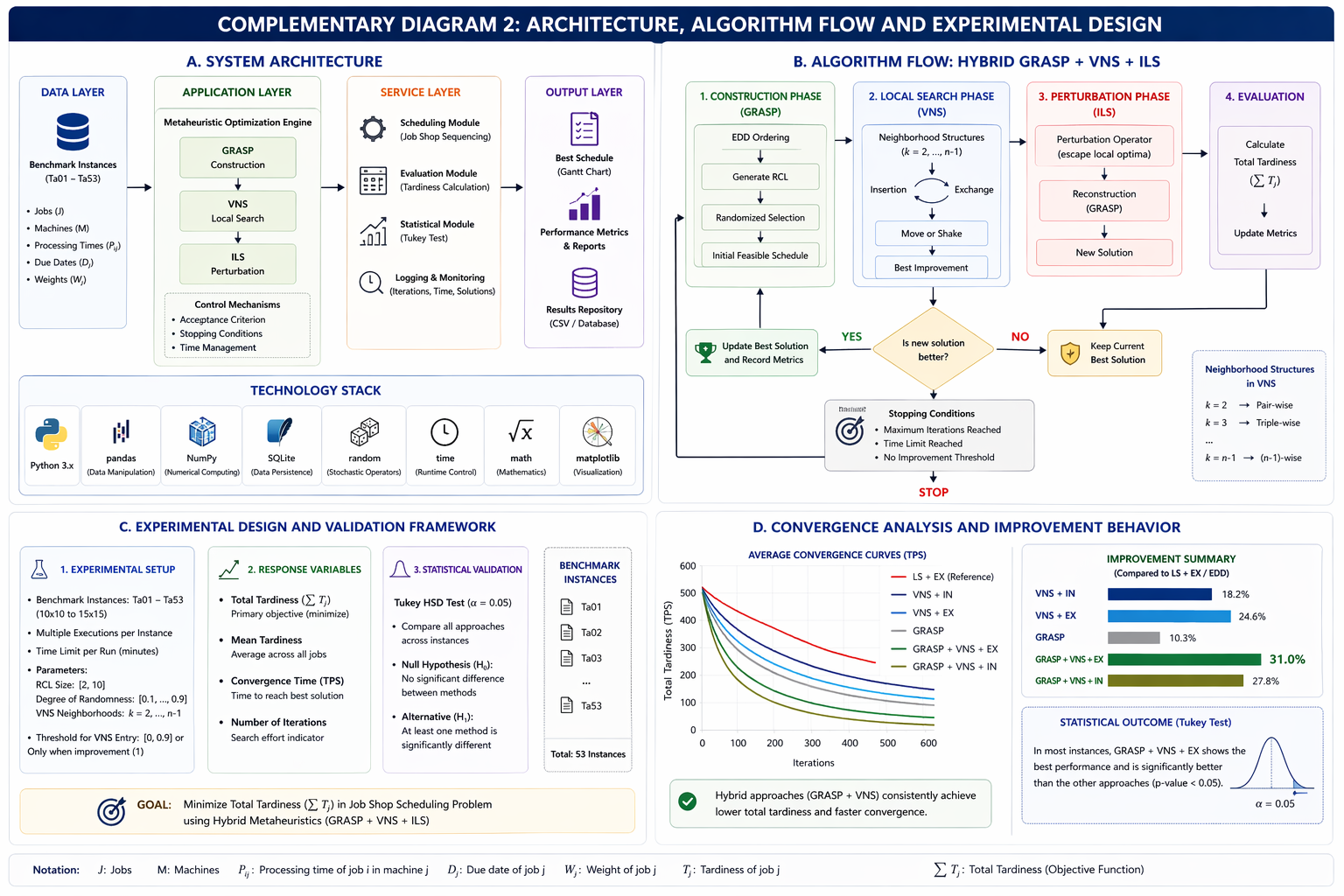
Experimental results demonstrated that hybrid metaheuristic approaches combining GRASP and VNS consistently achieved superior performance compared to standalone methods, particularly for larger problem instances.
The system was implemented using Python and evaluated in a controlled environment for reproducibility.
This project represents an applied optimization and algorithm design effort that integrates operations research, algorithm engineering, and industrial decision-support systems.
Programming Language
Python 3.x
Main programming language used for implementing metaheuristic optimization algorithms and experimental simulations in Job Shop Scheduling environments.
Core Python Libraries
pandas
Used for:
Data manipulation | Experimental result storage | Scheduling representation | CSV export | Performance tracking
NumPy
Used for:
Numerical computation | Matrix initialization | Scheduling simulation | Vectorized operations
sqlite3
Used for:
Persistent storage of benchmark instances | Structured data retrieval | Database-driven experimentation
random
Used for:
Stochastic solution generation | GRASP candidate selection | VNS neighborhood exploration
time
Used for:
Runtime control | Convergence measurement | Stopping criteria implementation
math
Used for:
Mathematical computations | Numerical evaluation
Matplotlib
Used for:
Gantt chart generation | Makespan visualization | Scheduling performance analysis | System Architecture Style
Scientific Computing Application
Characteristics:
-Algorithmic experimentation
-Metaheuristic optimization
-Iterative simulation
-Performance benchmarking
Metaheuristic Algorithms
-GRASP
-Variable Neighborhood Search (VNS)
-Iterated Local Search (ILS)
-Combinatorial Optimization
-Operations Research
-Statistical Analysis
-Scheduling Algorithms
The source code is not publicly available. This project is presented as a technical case study describing the system design, methodology, and performance results.
Framework: Optimization Algorithms | Python

Technology Stack:
Python | Pandas | pip | Sqlite3 | Numpy | time | math | matplotlib | Seaborn | Scipy | Statmodels
About Team
Company / Institution: Universidad del Bío-Bío, Industrial Engineering Department
Developer: Marco Antonio Parra Fernández Felipe T. Muñoz
The repository documents the problem, architecture and results of this case study. Source code is not published.
Project Images